Disposable Mask Waste Piles Up: Nature Is Threatened
The Covid-19 pandemic condition requires us to make some new habits as an effort to prevent the spread of the virus, one of which is wearing masks. Currently, masks are mandatory items that must be worn when leaving the house. According to the World Health Organization (WHO), disposable masks should be thrown away when they become damp. How to throw it can’t be careless, because discarded masks may have the potential to transmit the virus. In addition, waste can also pollute the environment. So, more and more people who wear disposable masks, the more garbage that accumulates.

Based
on data from the Indonesian Institute of Sciences (LIPI), the amount of
hazardous and toxic waste (B3) in Indonesia, including masks and personal
protective equipment (PPE), reached 1,662.75 tons during the pandemic, namely
from March to September 2020 (LIPI, 2021). In addition, in February 2021, the Sub Bidang Penanganan Limbah
Medis Satgas Covid-19 made a report on mask waste that polluted Jakarta Bay. At
the beginning of the Covid-19 pandemic in March and April 2020, the Satgas Covid-19
recorded a total of 4.1 kg of medical mask waste found in the Muara Cilincing
area. Meanwhile, in Muara Marunda during the same period, a total of 8.57 kg of
used masks were found. Now, you can imagine how much mask waste arises from a
single-use medical mask whose unit weight is only about 0.008 kg.

In addition, Oceans Asia, a non-profit organization in the field of marine conservation, released an annual report estimating 1.56 billion used masks polluted the ocean in 2020. The report stated that the mountain of mask waste was estimated to contribute 4,680 to 6,240 tons of plastic waste at sea. This is because the masks, which are generally made of polypropylene, break down into microplastics.
When
broken down, plastic breaks into tiny pieces known as microplastics and shrinks
again into nanoplastics. In the process, the decomposition of plastic into
microplastics absorbs toxins and organic pollutants. This means that marine
fauna can also be poisoned when ingesting microplastics. Meanwhile, research on
microplastics is still relatively new, so there is not enough data that shows
how harmful microplastics are to human health significantly. However,
microplastics may enter the human food chain (Selvaranjan et al., 2021).
Reporting from theguardian.com, mask waste that is still intact and "roaming" in the environment because it is not handled properly can be carried into rivers and seas and cause water pollution. In Mediterranean waters, these disposable masks even float like jellyfish (The Guardian, 2020).
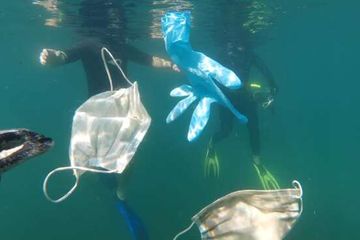
The
waste of used masks can also ensnare animals, and even cause death for them.
There are also cases where animals think that the used masks are food. If they
don't die from choking, the masks that escape will fill their stomachs, reduce
food intake, cause the animals to starve, and eventually die (The Conservation,
2020).
Knowing how dangerous mask waste is for the environment, then we should try to overcome it. We can start from ourselves, by managing the waste of masks that we use every day. Let’s save our environment, save our beloved earth. 😊
(ed:Rahma)
References:
Lembaga
Ilmu Pengetahuan Indonesia (LIPI). (2021). LIPI : Butuh Strategi Sinergi Multi Pihak untuk Pengelolaan Limbah
Masker. Accessed via
http://lipi.go.id/berita/lipi-butuh-strategi-sinergi-multi-pihak-untuk-pengelolaan-limbah-masker/22340 on 8 November 2021.
OceanAsia Organization. (2020). COVID-19
Facemasks & Marine Plastic Pollution. Accessed via https://oceansasia.org/covid-19-facemasks/ on 10 November 2021.
Selvaranjan, K., Navaratnam, S., Rajeev, P., &
Ravintherakumaran, N. (2021). “Environmental challenges induced by extensive
use of face masks during COVID-19: A review and potential solutions”. Environmental Challenges, 3, 100039. Accessed via https://doi.org/10.1016/j.envc.2021.100039 on 8 November 2021.
The Conversation. (2020). Coronavirus face masks: an
environmental disaster that might last generations. Accessed via https://theconversation.com/coronavirus-face-masks-an-environmental-disaster-that-might-last-generations-144328
on 10 November 2021 .
The
Guardian. (2020). More Mask Than Jellyfish, Coronavirus Waste Ends Up in
Ocean. Accessed via
https://www.theguardian.com/environment/2020/jun/08/more-masks-than-jellyfish-coronavirus-waste-ends-up-in-ocean on 9 November 2021.
Comments
Post a Comment